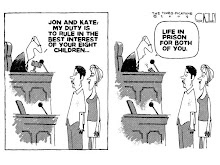
Following is an excerpt of Gloria Allred's testimony at the April 14, 2010 hearing on child labor laws hosted by
Pennsylvania Rep. Murt. Although the hearings were not about the Gosselins in particular, they would no doubt have not taken place if the Gosselin children being filmed here had not brought attention to the topic. Therefore, the Gosselins various shows being filmed in PA has provided us with a valuable opportunity to examine and improve our laws regarding children being filmed in entertainment here.
As I read through this first portion of Gloria's testimony I thought of some examples where, throughout this entire "reality" TV experience, the Gosselin's children's needs have not been treated as a priority. Rather than state my observations now, I invite my readers to consider the Gosselin children as they read the statement below, and then comment on how you observe this relating to the Gosselins. Then I'll post another entry listing some of your observations and including my own.
* * * * * *
Good Morning. I’m attorney
Gloria Allred, partner in the law firm of Allred, Laughlin, Goldberg in Los Angeles where I’ve been practicing law for almost 35 years. But most of all, I’m proud to be born in Philadelphia, Pennsylvania, graduate of Philadelphia High School for girls, a graduate of the University of Pennsylvania where I was given the honor of being a commencement speaker at the College of Arts and Sciences graduation on Franklin Field just a few years ago. And, also, I was a credentialed teacher at Benjamin Franklin School here in Philadelphia and some other schools as well in Philadelphia before I moved to California some years ago. So, thank you very much for holding this important hearing. Most of all, thank you to Representative Murt and to the other representatives who spent time here today listening very carefully. I’ve testified at numerous hearings on numerous subjects for many years and I have to say I’ve never seen elected officials so attentive and very thoughtful about the testimony that was being presented to them and really obviously looking for ways to resolve the important issues facing the children in Pennsylvania. So I thank you for that.
These children on reality shows don’t have a voice, they don’t make contributions to political campaigns, they don’t run for elective office and s they have no political clout. So ordinarily they got nothing but lip service , if that, from elected officials. But, obviously you are elected officials who want action and who want deeds not just words, and for that I’m very appreciative. What I’d like to talk about today is to give a short overview of what federal law does or does not do in this area, and also to, perhaps, give some analysis of Representative Murt’s proposals that I know he has not distributed, but we’ve had a chance to look at some of them and analyze them, and I’d like to emphasize what I think is positive about them and what perhaps could be a little bit clarified or improved. And then finally, I’d like to make some comments about the investigative process, and not specifically what’s going on with Jon and Kate, but the investigative process in terms of the law. I’ll give you an example, from California, in reference to an investigation that took place on the
Nadya Suleman and her eight, well actually fourteen children that she has and whether that process worked or not in reference to what would work here in Pennsylvania.* And I do want to commend
Jodi and Kevin Kreider who just gave incredible testimony , just perfect, and
Paul Petersen who is in the interest of full disclosure of my client, but who is absolutely the leader above all else on this issue in this nation and for that matter around the world.
To begin, federally, and this background is also provided by and has been provided to me by the American Federation of Television and Radio Artists, I am a member of
AFTRA and I’m also a member of
SAG. In reference to what the issue is federally, the most pleasing federal law that regulates the employment conditions and prevents the abuse of child workers issues is the
Fair Labor Standards Act, FLSA, child labor provisions under FLSA are designed to protect the educational opportunities abuse and prohibit their employment and jobs that are detrimental to their health and safety. The FLSA restricts the hours that youth under 16 years of age are allowed to work and with hazardous occupations too dangerous for young workers to perform. And here’s what’s most important: Children employed as actors or performers in motion pictures, theatrical productions, or on radio or television programs are specifically exempt from Fair Labor Standards Act coverage and the standards and protections provided under FLSA. So let’s talk now about how does the lack of coverage under the FLSA impact children. Without national coverage, children have no consistent protection. Though some states regulate the employment of minors in the entertainment industry, other states have no provisions regulating child labor in this industry whatsoever. Among the states that normally regulate the performances of children in the media industry, few have comprehensive protections for the education health , safety and financial security of children.
For years, children have necessarily been a part of the entertainment industry. It would be impossible to produce the Harry Potter films or television programs like Hanna Montana or the Suite Life of Zach and Cody without employing children as actors. And the proliferation of the so called reality programming has exacerbated the problem by utilizing children on television without any compensation or any other protection either as contestants or subjects of documentary style shows. Without the protections afforded under the FLSA, the welfare of children is put at risk. The recent hoax of the so-called balloon boy, reports that the Octomom was developing a reality TV show and the proliferation of shows like
Kid Nation, Jon and Kate Plus 8, or just Kate Plus 8 illustrates that children are increasingly exploited in the media and often without fundamental protection. Federal child labor standards in the entertainment industry would ensure that the well-being of children is not bothered for the proverbial fifteen minutes of fame. As film and television production becomes decentralized, more children than ever are left without protection. States with major entertainment industry production centers like California and New York do have well developed laws and regulations as Paul Petersen had said, governing the performance of minors in the industry. But production is increasingly decentralized particularly if more states like Pennsylvania pass production incentive legislation, that’s tax incentive legislation, designed to lure film and television production to their state. Though union contracts in the industry contain provisions designed to provide the unique protections that children require, many programs are not produced under a union contract. Additionally, the performances of some children like contestants and participants in reality television may not be covered by a union contract because the children are not technically “employed”.
So what protections are needed? First of all in the area of wages. There is currently no minimum wage for children who appear on air. Children who appear in competition or documentary-styled reality programs may not receive any compensation at all. This is nationally.
Financial protections. There are only four states that have a Coogan law requiring establishment of a trust account to preserve and safeguard a portion of their earnings for adulthood.
Health, safety, and working conditions. Children need health and safety protection that is specific to their physical, mental, emotional and developmental needs.
Education. States like California require that teachers be provided for children while they are working on production. California also requires the presence of a parent or a guardian while a child performer works. Other states may have no provisions at all for onset education.
Hours of work. Children need additional rest when working, particularly if they are traveling or working at night. Associate regulation of hourly support is necessary.
Moral oversights. Children should not be placed in a moral situation that is inappropriate, be exposed to distressing scenes, be forced to become distressed in order to prompt a particular reaction or employed in any situation involving nudity, which goes to your concerns, Representative.
Representative Murt, I know, has drafted some proposed improvements or changes in Pennsylvania Child Labor Law and without going through all of them because I think that’s in the province of Representative Murt to present, I would like to comment that I think it’s very positive that he wants to define work in reality shows. His proposals for legislation will require that children who appear on reality television are working as performers and should be subject to the state’s (??) process for child performers.
Minimum wage recommendation by Representative Murt: The legislation which he proposes will recognize that children in reality television should be paid for their performances, or their participation, and that the work load and restrictions in place for children working in other types of television programming such as scripted entertainment programming should be in place for kids in reality television. I see that as a positive as well.
Moral oversight. Representative Murt’s proposed legislation has some provisions related to moral oversight. Meaning prohibitions on photographing children while changing clothes, or bathing, performances where alcohol is present. Additional protections would be helpful. I’ll make a few specific suggestions there.
Health and safety. Representative Murt is concerned with that. His legislation contains provisions related to health and safety, which are good. States should study to see whether (?) protection are necessary.
Now here are some areas that I believe could perhaps benefit from some clarification, Representative Murt, for improvement.
Age of children. The permitting process in Pennsylvania is such that appears that children under the age of seven are not permitted to work. If this is the case, the same restriction should exist for children in reality shows. It would eliminate ambiguity if the legislation were to contain a clearly-worded prohibition against the employment of children under the age of seven in reality shows.
Hours of work. They provide, in Representative Murt’s legislation, that children shall not work before five a.m. or after 11:30 p.m. It strikes me that that’s rather early and extremely late particularly for children as young as seven years of age. Similarly, permitting up to forty four hours of work per week as a proposed legislation and draft suggests, seems to be quite a lot, and I would lessen that.
Financial protection. Only four states, as I have mentioned, have a
Coogan Law requiring establishment of a trust account to preserve and safeguard a portion of the children’s earnings for adulthood. Pennsylvania is not one of those states.
Education. States like California require that teachers be provided while they are working on production. By the way, the purpose of the teacher is merely to safeguard the workplace so the children are not endangered. California also requires the presence of a parent or guardian while a child performer works. It’s good that Representative Murt is asking the department to ensure that adequate educational instruction is provided. But the standards they have to meet needs to be defined in my opinion.
Moral oversight in Representative Murt’s proposed legislation. Children should not be placed in a moral situation that is inappropriate, be exposed to distressing scenes, be forced to become distressed in order to prompt a particular reaction. There’s a real risk that these sorts of things can be problems during the production of television reality shows.
[End of the excerpt of Allred's testimony]
*Due to the length of this post that example will be provided in a future blog entry.